

Taking aluminium etching to new heights

Aluminium remains a material of choice across aerospace, with many commercial aircraft relying on aluminium alloys for roughly 80 per cent of their structural weight. But how can manufacturers produce aluminium components with the accuracy, repeatability and cost efficiency required for next-generation aerospace applications when the material itself is notoriously difficult to etch? Here, Ben Kitson, head of business development at chemical etching specialist Precision Micro, explains how new etching capabilities for aluminium meet the requirements of aerospace applications.
Aluminium has long been a go-to material for aircraft, combining low weight with the strength needed for flight. Used in structural components to internal fittings, it helps reduce fuel consumption and emissions while increasing payload.
What’s more, the scale of future aircraft demand makes lightweighting important. Airbus forecasts demand for 42,060 new aircraft over the next 20 years, while global passenger traffic is expected more than double and reach approximately 10 billion passengers per year by 2045.
This puts aluminium in the spotlight, with traditional commercial narrowbodies, like the Boeing 737 or Airbus A320, being composed of roughly 70-80 per cent aluminium by structural weight.
That figure, approximated by the National Academies of Sciences in its landmark report on aerospace materials, highlights exactly why choosing the right manufacturing processes for aluminium components is so important.
Why aluminium is difficult to etch
Aluminium offers an attractive combination of low weight, strength, corrosion resistance and thermal conductivity. However, its reactivity makes it particularly challenging to process using conventional chemical etching methods, which is a subtractive manufacturing process that uses chemicals to remove parts of sheet metal.
During etching, the exposed metal reacts with the chemical etchant in an electrochemical process, with metal atoms being oxidised by the reagent. This reaction is exothermic, meaning it generates heat.
If that heat is not carefully controlled, the etching reaction can become increasingly difficult to regulate, affecting the resulting edge profile and dimensional accuracy.
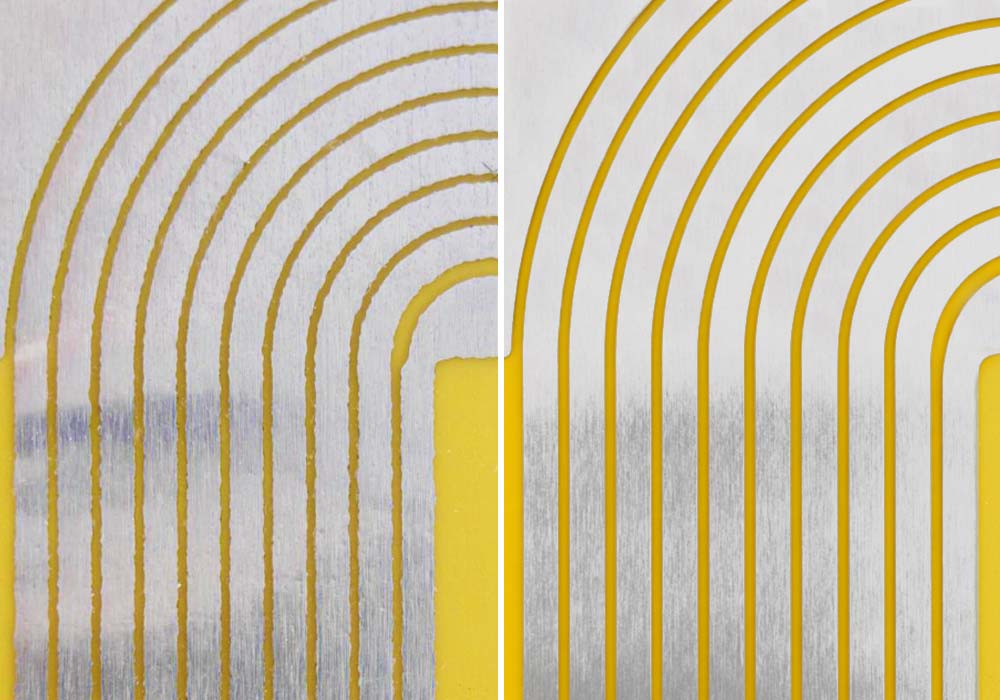
Historically, this has contributed to rough, granular edges when aluminium is chemically etched. For aerospace applications, where repeatability matters as much as the initial design, that can make conventional etching unsuitable.
Manufacturers have therefore had to develop greater control over chemistry, temperature, material preparation and process conditions to make aluminium a viable precision-etched material.
Lightweighting without compromising
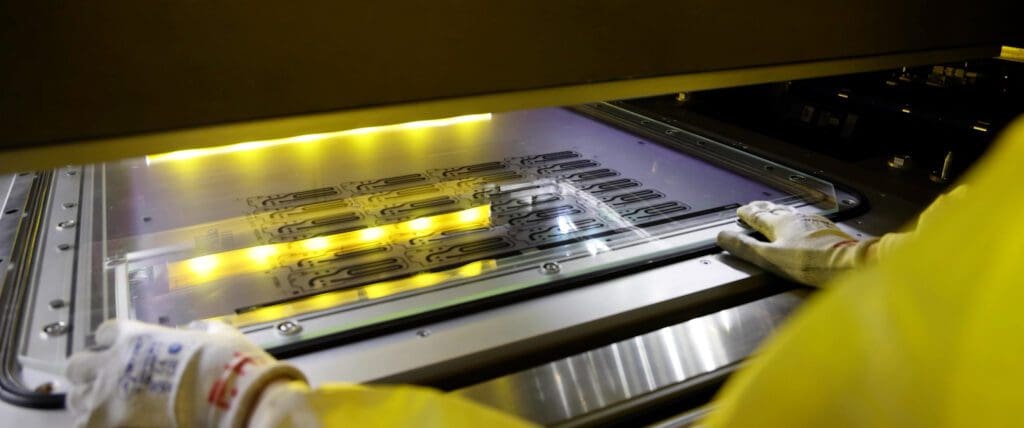
Chemical etching removes material without mechanical force or the concentrated heat associated with processes like machining and laser cutting, avoiding mechanical stress, burrs and heat-affected zones.
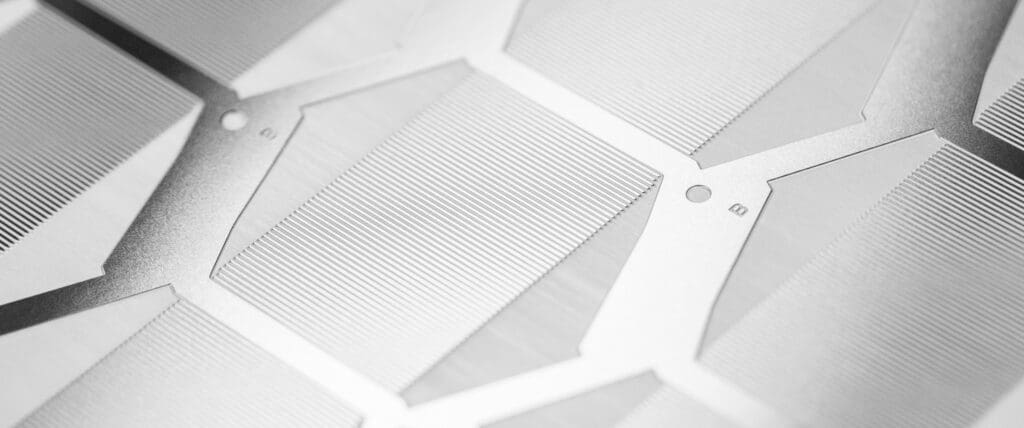
The use of digital tooling also allows intricate geometries to be produced without a cost penalty, with tolerances as tight as ±0.020mm achievable. For aerospace engineers, that creates opportunities to design lightweight components that would be difficult to manufacture economically using conventional processes.
Applications include aluminium heat exchanger plates with complex channels, where chemical etching can create intricate flow paths and maximise surface area for efficient thermal management, while reducing the overall size and weight of the assembly.
Air intake grilles for helicopters and unmanned aerial vehicle (UAV) components can also benefit from the process, particularly where complex geometries need to be produced without introducing distortion or burrs.
Dehumidifier heater plates for aircraft cabins are another example. Here, chemical etching can produce intricate, repeatable profiles while allowing components to be stacked efficiently within the final assembly.
Precision is only useful if it is repeatable
AS9100, the quality management standard for aviation, space and defence organisations, mandates consistency and quality across the supply chain. For chemical etching, this makes process consistency critical.
Controlling the chemistry and exothermic reaction is not only about producing a visually clean component, but ensuring the same geometry can be produced repeatedly, with predictable material and dimensional characteristics.
Modern processes can produce smoother edge profiles, tighter tolerances and complex geometries while maintaining the lightweight characteristics that made aluminium attractive in the first place.
For aerospace manufacturers, the challenge is not simply finding a lightweight material, but a manufacturing process that preserves its advantages while delivering the precision and repeatability required for production.
Chemical Etching Whitepaper
Learn how chemical etching can overcome the limitations of traditional sheet metal machining technologies.
DownloadLatest Articles